

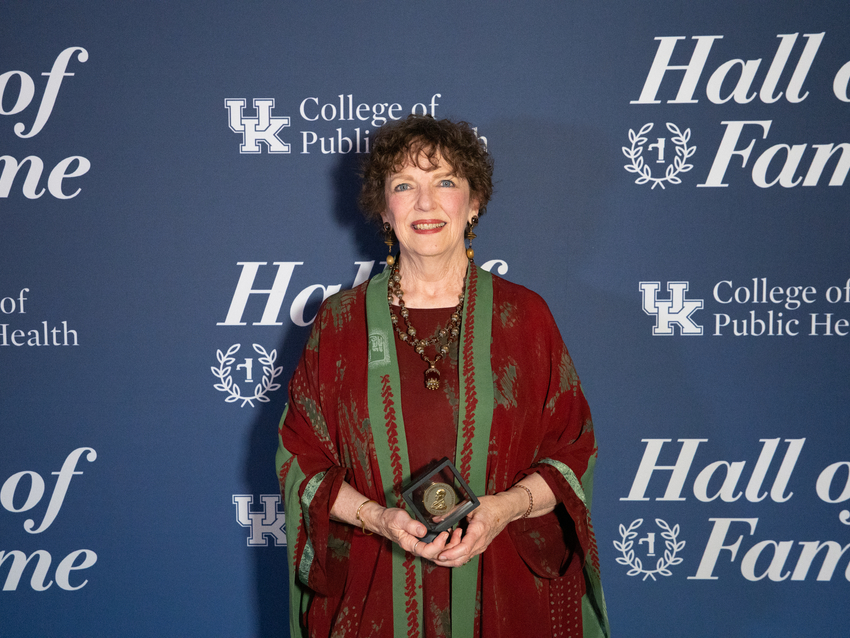
Connie White’s career of care earns College of Public Health’s highest honor
From caring for patients as an obstetrician and gynecologist in Frankfort to helping shape public health initiatives across Kentucky, Connie Gayle White has built a career around improving the lives of others. She has spent decades bringing people together to address the health needs of Kentucky’s women, infants and communities, with a lasting impact that extends far beyond the exam room.
For those decades of work, White was honored with the Hume Medallion Award, the University of Kentucky College of Public Health’s highest accolade.
“For one of the rare times in my life, I don’t have words,” said White, M.D., M.S., of receiving the award. “I feel that I have used a position where I can rally people toward a cause.”
Her response reflects the humility that has accompanied a career spanning clinical practice, public health administration and statewide initiatives addressing maternal and infant health, chronic disease, substance use disorder and other challenges affecting communities across the Commonwealth.
The Hume Medallion is awarded to an exceptional public health practitioner or organization whose work has made a significant impact on the nation, the Commonwealth of Kentucky, the University of Kentucky (UK) or the College of Public Health (CPH). The award is granted solely based on merit and service; recipients are not required to be alumni of the institution.
White’s path to public health leadership was not a straight line. After earning a chemistry degree from Kentucky Wesleyan College, she was uncertain about her next steps and decided to pursue a master’s degree at UK. She joined one of the first classes of graduate students in UK’s newly established toxicology department before taking a position in birth defects research at the National Center for Toxicologic Research in Arkansas.
The laboratory environment, however, was not a long-term fit. After two years, White applied to medical school and returned to UK, where she completed her medical education before pursuing an OB-GYN residency at the University of Louisville.
White went on to practice obstetrics and gynecology in Frankfort for more than 20 years, building relationships with patients and families while developing a firsthand understanding of the barriers that can affect access to care. More than half of her practice involved patients covered by Medicaid, an experience that helped shape her understanding of the relationship between individual health needs and broader public health challenges. This association led her to champion awareness of both Adverse Childhood Experience and Positive Childhood Experiences in a person’s life trajectory.
“I think I was able to mesh the academic knowledge, patient situations, public health landscape and how things could happen to patients/families and then some just very basic common sense,” she said.
In 2009, White made the transition from clinical practice to public health leadership, becoming director of the Division of Women’s Health at the Kentucky Department for Public Health (KDPH). The division brought together efforts focused on family planning, breast and cervical cancer screening and adolescent health — areas that aligned with her professional interests and commitment to women’s health.
When budget cuts interrupted that first chapter at the department, White joined CPH for a period before returning to KDPH. She ultimately served as deputy commissioner of clinical affairs, advising on a broad range of public health issues and helping the department consider how policies and initiatives would affect physicians, healthcare providers and patients.
Her responsibilities extended well beyond women’s health. White contributed to initiatives involving chronic disease, diabetes, emergency preparedness, COVID-19, opioid overdose prevention and community health workers. She also helped advance the Kentucky Perinatal Quality Collaborative and efforts surrounding the Maternal Mortality Review Committee.
“I’ve been here at a time when doors opened and I took them,” White said. “When I’m talking to people about their careers, I tell them that you have a plan, and then you look for those doors or open windows. You take them because they’re going to lead you places you never imagined you would be.”
White considers the Kentucky Perinatal Quality Collaborative a particularly special part of her career. Bringing together healthcare providers, birthing hospitals and other partners to improve maternal and newborn care, the collaborative represents the kind of coordinated, data-driven approach White believes can make a lasting difference. She first became interested in the process while still in medical practice and has been proud to see the work develop.
She is equally proud of Kentucky’s community health worker (CHW) program, which she helped advance over several years. Work began at KDPH in 2014, and CHW certification was established in 2019, creating a foundation for a stronger statewide program.
For White, such accomplishments demonstrate the persistence required to make improvements in public health.
“I had a colleague ask me if anything ever happens quickly around here (KDPH). I told him ‘no’, but when it does happen, it changes lives across the commonwealth,” she said.
That persistence continues in her current work with Kentucky’s Centers for Medicare and Medicaid Services Rural Health Transformation Program, which addresses chronic disease, maternal care, behavioral health, oral health and EMS capacity across rural communities. After planning to retire following decades of public health service, White returned to help launch the PoWERing (People who Work for Engagement and Resilience) Rural Maternal and Infant Health initiative, expanding prenatal and postpartum care in maternity-care deserts and high-risk rural regions, along with enhance newborn care, by deploying patient enabled teams with a nurse, doula and community health worker for each patient and supporting telehealth-enabled maternal care teams.
Although White has helped advance major statewide initiatives, she measures her influence in smaller moments, too. Throughout her career, she has encouraged colleagues, helped emerging leaders develop their skills and worked to recognize public health professionals whose contributions often happen outside the public eye.
White said she understands that much of the work she and other public health team workers have contributed to the progress of Kentucky’s health may never be widely recognized. For her, that is not the point.
“I just want people to think of me as someone who cared about people and she did things to try to help them reach their full potential,” she said.
For White, public health is an extension of her faith and her commitment to helping others. Whether supporting a patient, encouraging a colleague or helping establish systems intended to improve health outcomes for generations, she measures success by the difference it makes in people’s lives.
And while the Hume Medallion Award recognizes her decades of service, White considers her work far from finished.
“I'm overwhelmed. I'm honored beyond words and I’m not done yet, so I hope I can continue to live up to this honor,” she said.